How AI Is Solving the Biggest Challenges in Manual Video Editing
AI is changing manual video editing by carrying project context, handling repetitive work, and helping creators protect story, continuity, and creative control.
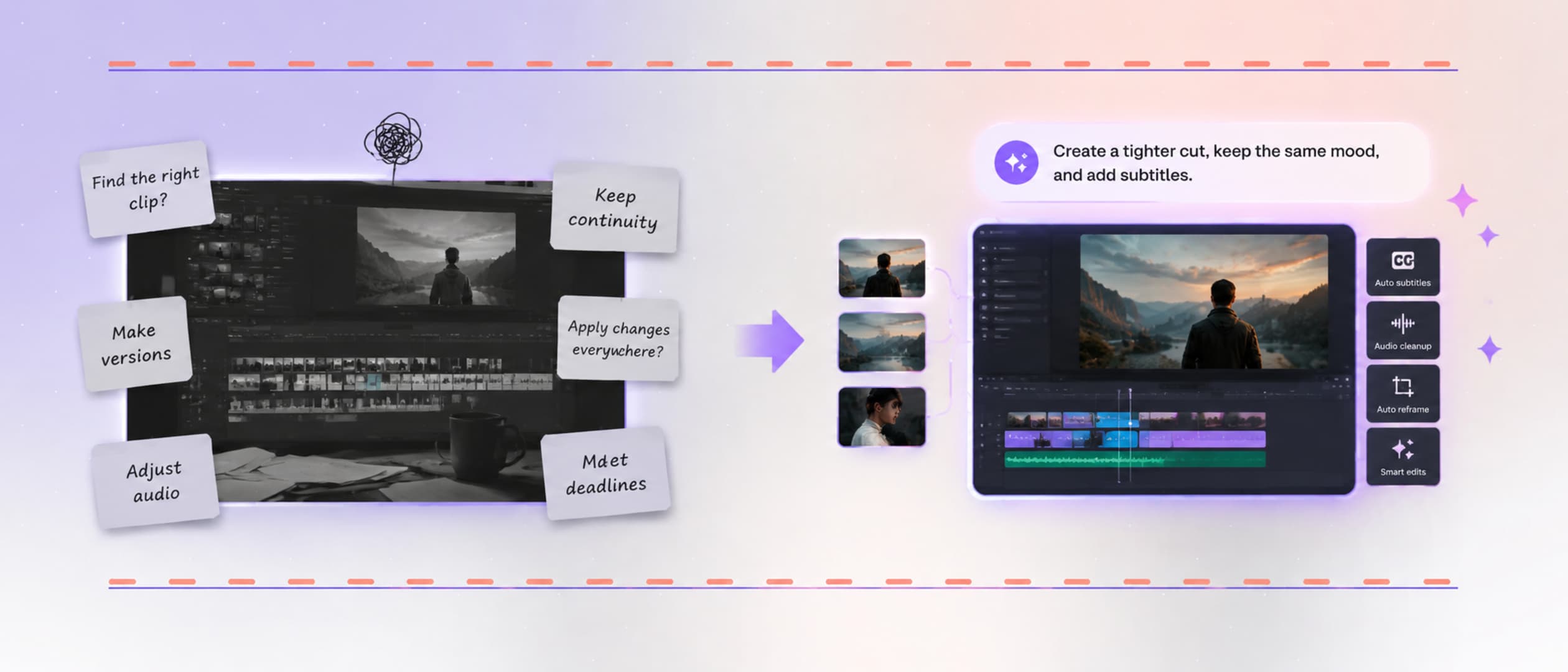
Video editing has always sat at the intersection of craft and execution. It's the stage where raw footage becomes a story, where scattered shots turn into sequences, and where a creator's idea finally takes a shape someone else can watch.
But as video production has grown more ambitious, editing has grown more complicated with it. A single project can now involve hundreds of clips, multiple cuts, external assets, brand guidelines, several collaborators, and an overwhelming number of small creative decisions. Editing tools have kept getting more powerful, but the process underneath them, organising, searching, cutting, adjusting, and refining, has stayed mostly manual.
For creators working at scale, editing a video was never really the hard part. Managing everything happening around the edit is.
AI is starting to change that, not by bolting more automation onto old workflows, but by introducing systems that can understand the intent behind a project and help creators move from idea to finished cut faster.
Where traditional editing workflows break down
Traditional editing software hands creators enormous control. Every frame can be manipulated, every transition adjusted, every sound layer refined. That precision is exactly what makes professional editing possible.
It's also where the time goes.
A large share of an editor's day isn't spent making creative choices, it's spent finding the right footage, organising assets, building out versions, applying the same adjustment across a dozen clips, and making sure nothing drifts out of consistency along the way.
For a short video, that's manageable. For a film, a campaign, a series, or a brand's ongoing content, it adds up fast. The editor ends up responsible not just for the story but for holding the entire project in their head:
- Which takes approval
- Which version actually matches the director's note
- Which details need to stay consistent across scenes
- Which moments still need more coverage
- Which changes need to ripple across every edit that uses them
As a project grows, simply remembering all of this becomes one of the hardest parts of the job.
Editing was never just moving clips on a timeline
The timeline is the foundation of modern editing, but a finished video is more than clips arranged in order.
Every real editing decision is made on meaning, not mechanics. A close-up that works beautifully in one scene might feel intrusive in another. A cut can connect two shots perfectly and still flatten the emotional rhythm between them. A performance might need an extra half-second to land before the next line comes in.
None of that comes from the footage alone; it comes from understanding how shots relate to each other, how scenes build a story, and where a character or idea is headed.
Traditional tools are built around operations: cut this, move that, adjust this transition. They're powerful, but they leave all the translation, from creative intent into individual actions, up to the editor.
AI introduces something different: a system that doesn't just see clips but understands the role each clip is playing inside the larger project.
The real shift: from giving commands to giving direction
The biggest change AI brings to editing isn't a new button. It's a new way of talking to the software.
Traditional workflows ask creators to specify actions. AI-powered workflows let creators describe outcomes.
Instead of manually digging through footage and rebuilding a sequence by hand, a creator can just say what they want:
- "Create a shorter version of this scene."
- "Find a stronger opening."
- "Make this sequence feel faster."
- "Build alternate cuts for different audiences."
The AI handles the execution. The creator stays focused on the decision.
This doesn't sideline the editor, it changes what the job actually looks like. Instead of managing every individual operation, the editor is guiding a process. Taste, storytelling, and the final call still belong entirely to the human. AI just absorbs the repetitive work required to get there.
This is the direction tools like Invideo editor are built around. It puts AI editing agents directly on a professional timeline: you upload your footage, give direction in plain language, and the agent reviews the material, selects the usable takes, cuts the repetition, and assembles a base cut, a full first pass, not a highlights reel, that you can then keep shaping by hand. The execution gets handed off. The timeline, and every decision made on it, stays yours.
Solving the problem of project memory
One of the quieter limitations of traditional editing is that most of the creative context lives outside the editing tool.
A director has a visual style in mind that was never written down anywhere the software can see. A brand team has guidelines buried in a shared doc. A filmmaker established a character detail three scenes ago that now needs to hold for the rest of the cut. Keeping all of it consistent takes constant manual cross-referencing.
AI-powered workflows close that gap by letting the editing system hold more than just the raw footage; it can carry the surrounding project context too: creative rules, reference material, approved assets, and decisions made earlier in the process.
That matters most on larger productions, where a single video might contain dozens of scenes, multiple characters, and hundreds of small choices that all need to agree with each other. Instead of starting from zero every session, the system can pick up exactly where the project left off.
Cutting repetitive work without cutting creative control
A fair question about AI in any creative process is whether automation quietly erodes human judgement.
It shouldn't, and in a well-built workflow it doesn't. The most important calls in editing – what a moment means, how a story should move, when a cut should land, still come from a person. AI earns its place by taking on the work that consumes hours without requiring any of that judgement, building out multiple versions, organising assets, surfacing the right footage, and applying a repeated change across an entire timeline.
Freed from that load, creators get more time back for the part that actually needs them: storytelling, pacing, emotional timing, and creative direction.
The best AI editing tools aren't trying to make creators less involved. They're trying to make the time creators do spend count for more.
Collaboration gets easier when the system understands the project
Video production is rarely a solo act. A single project might move through directors, editors, producers, marketers, designers, and clients, each with their own read on what's working.
As a team grows, staying aligned gets harder. One person's note can ripple into parts of the edit nobody else is tracking. Feedback scatters across messages, documents, and review calls until it's hard to tell what's actually been decided.
AI-powered editing environments help by giving everyone a shared foundation to work from. When the system understands the creative context, not just the footage, collaborators can apply feedback, test alternatives, and make changes that stay tied to the project's original intent, instead of drifting from it. Teams end up spending less time managing the workflow and more time actually improving the cut.
The future of editing is about understanding, not just automation
The next real step forward in editing isn't adding more AI features to the same old tools. It's editing systems becoming genuinely aware of what a creator is trying to build, the story behind the footage, the purpose of each scene, how shots relate to one another, the rules specific to that project, and the decisions already locked in.
That doesn't replace the timeline. It puts the timeline inside a larger creative environment where humans and AI can actually work together, with precise manual control still available whenever it's needed and AI support ready for the complex, repetitive work that used to eat entire days.
Video production isn't getting simpler. But creators no longer have to manage that complexity by themselves. AI is turning editing from a job about manual execution into one about creative direction, and the editors who thrive next won't be the ones who can perform operations the fastest. They'll be the ones who can communicate a vision clearly and make good decisions quickly.
The craft doesn't go anywhere. It just gets more room.
Ready to create?
Start generating amazing content with AI