The AI Filmmaker's Biggest Challenge Starts After Generation
AI can generate shots quickly, but filmmakers still need to shape them into coherent stories with consistent characters, visual rules, pacing, and intent.
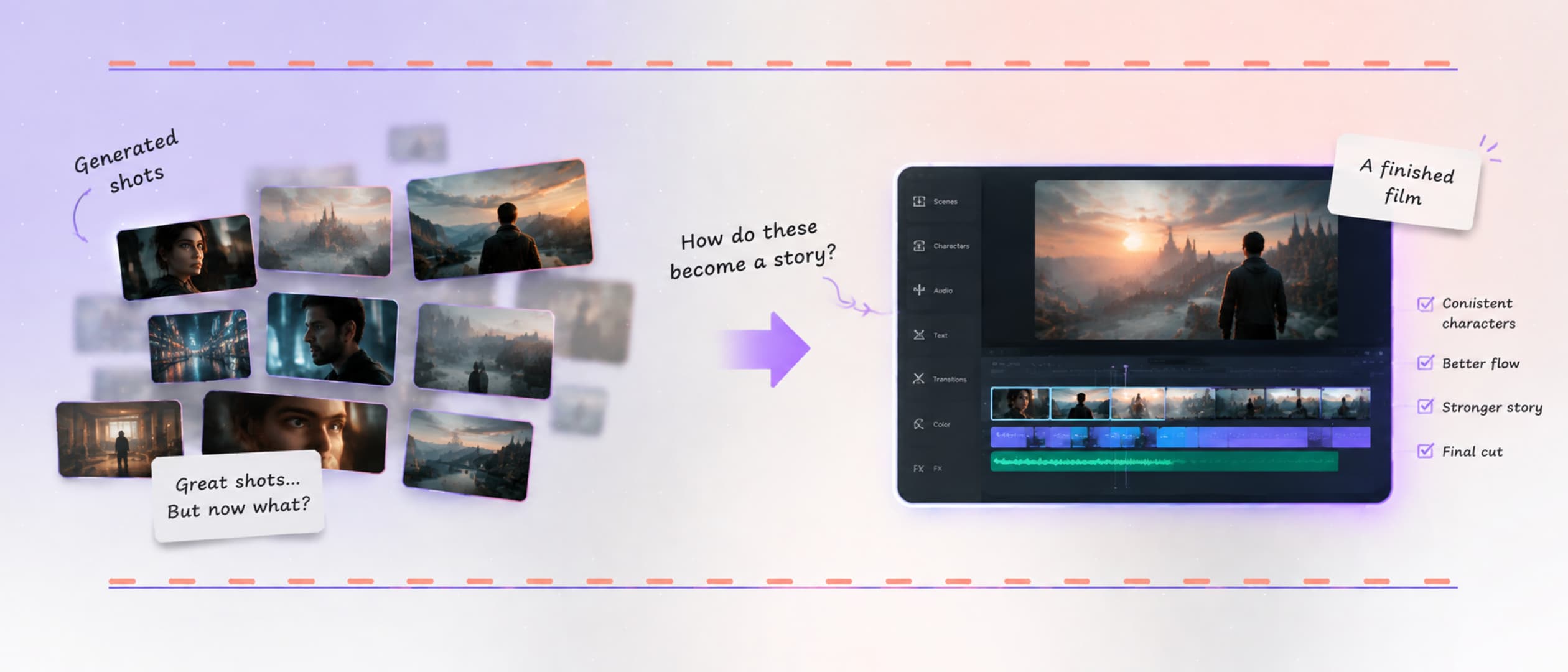
Generating video is only the beginning
AI has changed how filmmakers work. An idea can now become a character, a location, a full scene, or even a sequence in a fraction of the time production used to take. Concepts that once needed weeks of planning can be visualised in an afternoon.
But creating individual shots is only one part of filmmaking. The real challenge starts after generation.
A film isn't a pile of clips. It's a chain of decisions, which shots belong together, how scenes connect, whether a character stays recognisable, how pacing feels, and whether every choice still serves the original idea. As AI-generated footage gets easier to produce, the bottleneck stops being how much you can generate and becomes how you turn what you generated into something coherent.
Generation has largely been solved. Filmmaking hasn't.
Compression doesn't remove the craft
Traditional filmmaking unfolds in stages: a director shapes the idea, a production team plans the shots, performers act, cinematographers capture the image, and editors assemble it all into a story.
AI compresses much of this, a creator can generate visuals in minutes that once took a full shoot day. But compressing the timeline doesn't compress the judgement required. A generated shot can look striking on its own and still fail the scene around it.
- Does it match the shot before it?
- Does the character look like themselves from ten minutes ago?
- Does the lighting hold up across the sequence?
- Does the camera language stay consistent?
None of these are generation problems. They're filmmaking problems, and they don't disappear just because the footage arrived faster.
The real shift AI creators need to make isn't learning to generate more — it's learning to move from creating moments to building worlds.
From individual clips to a complete story
No filmmaker judges a film one frame at a time. They think in terms of:
- How a scene opens and closes
- How a character changes across the runtime
- How a visual choice earns an emotional reaction
- How one shot hands off naturally to the next
AI generation tends to produce volume, dozens of takes, versions, and variations on the same idea. That volume is genuinely useful, but it creates a new problem: deciding what actually belongs in the final cut.
More footage doesn't make a better film. What creators need isn't more output, it's a way to organise, understand, and shape what they already have into something structured. The next stage of AI filmmaking isn't about producing more shots. It's about helping creators direct the shots they already have into sequences that mean something.
Consistency gets harder, not easier, when everything can be generated
Traditional productions manage continuity through process: character design bibles, costume notes, location scouting, and shot lists, with script supervisors tracking every detail by hand.
AI filmmakers hit the same wall, just at a different scale and often without the process built to catch it. A character created in one generation needs to hold steady across:
- Multiple camera angles
- Different environments
- Different emotional beats
- Different episodes, versions, or campaign variations
A location has to feel like the same place every time it reappears. A visual style has to stay recognisable. A brand film has to keep its identity intact from one cut to the next.
Without a system that understands how these elements relate to each other, creators end up spending their time fixing inconsistencies instead of building the story, the opposite of what AI was supposed to free them up to do.
The missing layer is project understanding
Every experienced filmmaker carries context in their head: why a shot exists, why a character reacts a certain way, and why a specific visual choice was made over another. That context is what keeps a film coherent even as hundreds of small decisions accumulate.
AI systems need the same kind of memory. A workflow that only sees individual clips will keep losing the thread. A workflow that understands the project, the story being told, the characters involved, the visual rules already established, the decisions already made, and how each scene relates to the ones around it can actually help hold a film together.
That's the difference between AI as a generation tool and AI as a creative collaborator: one produces material, the other helps protect the filmmaker's intent as that material gets shaped into something finished.
Editing is where the story actually gets built
Once the footage exists, editing is where a film becomes a film. That's more than arranging clips on a timeline; it's a series of judgement calls:
- Which take carries the strongest performance
- Where a scene needs more room to breathe
- Which shot lands the emotional beat
- How one scene should flow into the next
- What should be cut entirely
For AI filmmaking to grow up, editing has to become as intelligent as generation. Creators shouldn't have to manually rebuild all that context, character details, visual rules, and story logic once they move from generation into the edit. The editing environment should already know what guided the footage into existence, so the workflow stays continuous from first idea to final cut instead of resetting at every stage.
This is the gap tools like invideo editor are starting to close. It brings AI editing agents directly onto a professional timeline, so a filmmaker can hand over raw or generated footage, describe the assembly they want, and get back a base cut, takes selected, removes repetition, and builds a sequence without losing the thread between what was generated and what gets edited. The project stays in one place instead of scattering across a generation tool and a separate editor.
The next wave isn't more clips; it's what happens after them
The first wave of AI video was about creation: turning text into images, images into motion. The next wave is about everything that comes after that moment.
- How do you organise hundreds of generated shots into something usable?
- How do you keep characters and visuals consistent across a whole project?
- How do you produce new versions without rebuilding the project from scratch each time?
- How do you collaborate with a team while keeping the original creative intent intact?
These questions, not raw output volume, will define the next generation of AI filmmaking. The workflows that win won't be the ones generating the most content. They'll be the ones that help creators make better decisions with what they've already made.
From generation to direction
The future AI filmmaker isn't someone who types a prompt and waits to see what comes back. It's someone directing a process, defining the world, setting the rules, making the calls, and guiding a vision through every stage, from planning to generation to editing to finishing.
The biggest challenge after generation is also the biggest opportunity: turning unlimited possibility into something that feels intentional.
Filmmaking was never really about how much footage you could make. It has always been about knowing which moments matter.
Ready to create?
Start generating amazing content with AI